
You’ve polished your CV, hit “apply”, and then heard nothing. It’s natural to wonder whether a person ever saw it, or whether software quietly filtered it out first. For many tech roles, the honest answer is that both may happen: an applicant tracking system (ATS), sometimes with AI features, organises and ranks applications, and then a recruiter or hiring manager decides who to call.
That means your CV needs to work for two readers at once. This guide explains how CV screening works today, what genuinely helps you get through, the myths to ignore, and how to make sure the human who reads it next wants to meet you.

How CV screening works now
An ATS is the software employers use to collect applications, track candidates and manage hiring. Many systems can parse your CV into fields, search it for skills and rank candidates against a job description. Some now add AI features that summarise profiles or suggest matches.
Candidates are aware of this. In a Gartner survey of 2,918 job candidates, 52% believed AI was screening their application information, and only 26% trusted AI to evaluate them fairly.
There’s a real reason to take screening seriously. In the landmark Hidden Workers: Untapped Talent study by Harvard Business School and Accenture, more than 90% of employers surveyed said they used recruiting software to filter or rank candidates, and 88% agreed that qualified high-skills candidates were vetted out because they didn’t match the exact criteria in the job description. The lesson isn’t that software is your enemy. It’s that a strong candidate can be missed if the CV doesn’t clearly show the match.
In Europe, there’s also a regulatory angle. Under the EU AI Act, AI systems used to analyse and filter job applications and evaluate candidates are classed as high-risk, with stricter obligations for the organisations that provide and use them.
Myths to ignore
- “A robot rejects 75% of CVs.” You’ll see precise figures like this shared widely, often without a clear source. How much is automated varies hugely between employers, and many recruiters still review applications themselves. Write a clear, relevant CV rather than trying to game a statistic.
- “Hide keywords in white text.” Tricks like invisible keywords or pasting the whole job description into your CV can backfire badly when a human opens the file. Don’t do it.
- “Plain means boring.” An ATS-friendly CV can still look professional. The goal is a clean structure, not a bare text file.
Write for the software: an ATS-friendly checklist
- Use a simple, single-column layout. Tables, text boxes, columns and graphics can confuse some parsers, so keep the main content in a straightforward flow.
- Use standard section headings. “Experience”, “Education”, “Skills”, “Languages” and “Certifications” are easy for both software and people to recognise.
- Mirror the job description’s language, honestly. If the role asks for “Kubernetes” and “CI/CD” and you have that experience, use those exact terms rather than a vague synonym. Only include skills you can talk about in an interview.
- Spell out acronyms once. Writing “site reliability engineering (SRE)” helps both keyword searches and human readers.
- Put contact details in the body, not the header or footer, and include your city, phone, email and LinkedIn URL.
- Choose the right file format. Follow the employer’s instructions. If none are given, a text-based PDF or Word file usually works; avoid scanned images of your CV.
- Use clear job titles and dates in a consistent format, so your career history parses correctly.

Write for the human: what makes them call you
Getting through screening is only half the job. The recruiter who opens your CV next may spend very little time on a first read, so make it easy for them:
- Lead with a sharp summary. Two or three lines that say who you are, what you do best and the kind of role you want.
- Show results, not just duties. “Cut deployment time from hours to minutes by automating releases” says far more than “Responsible for deployments”. Use numbers where you genuinely have them.
- Tailor the top third. Move your most relevant experience and skills for this role to the top.
- List languages clearly. For international roles in places like Amsterdam, Barcelona or Munich, your languages and level are often a deciding factor.
- Keep it tight. One to two pages is enough for most tech roles. Cut old or irrelevant detail.
- Proofread. Typos still cost interviews. Ask someone else to read it, or read it aloud yourself.
Using AI to help with your CV, carefully
AI tools can help you spot missing keywords, tighten long bullet points or compare your CV with a job description. Use them as an editor, not an author. Keep every fact, date and figure accurate, keep your own voice, and remove anything that sounds generic. Recruiters see a lot of AI-polished CVs, and specific, honest detail is what stands out.
Get it done properly: CV Rewrite
If you’d rather have an expert handle it, our Professional CV Rewrite, Redesign & Proofreading service costs €49 and is built for exactly this two-reader problem. Each order is for one specific job application and includes:
- an ATS-friendly CV as a Word file, plus a PDF with design options;
- LinkedIn profile text and a LinkedIn banner, delivered first;
- a targeted cover letter once the role is known;
- one revision round within 14 days.
You send your current CV, your LinkedIn profile and the job description you want to apply for (or a target job title), and we do the rest.
Then get in front of people
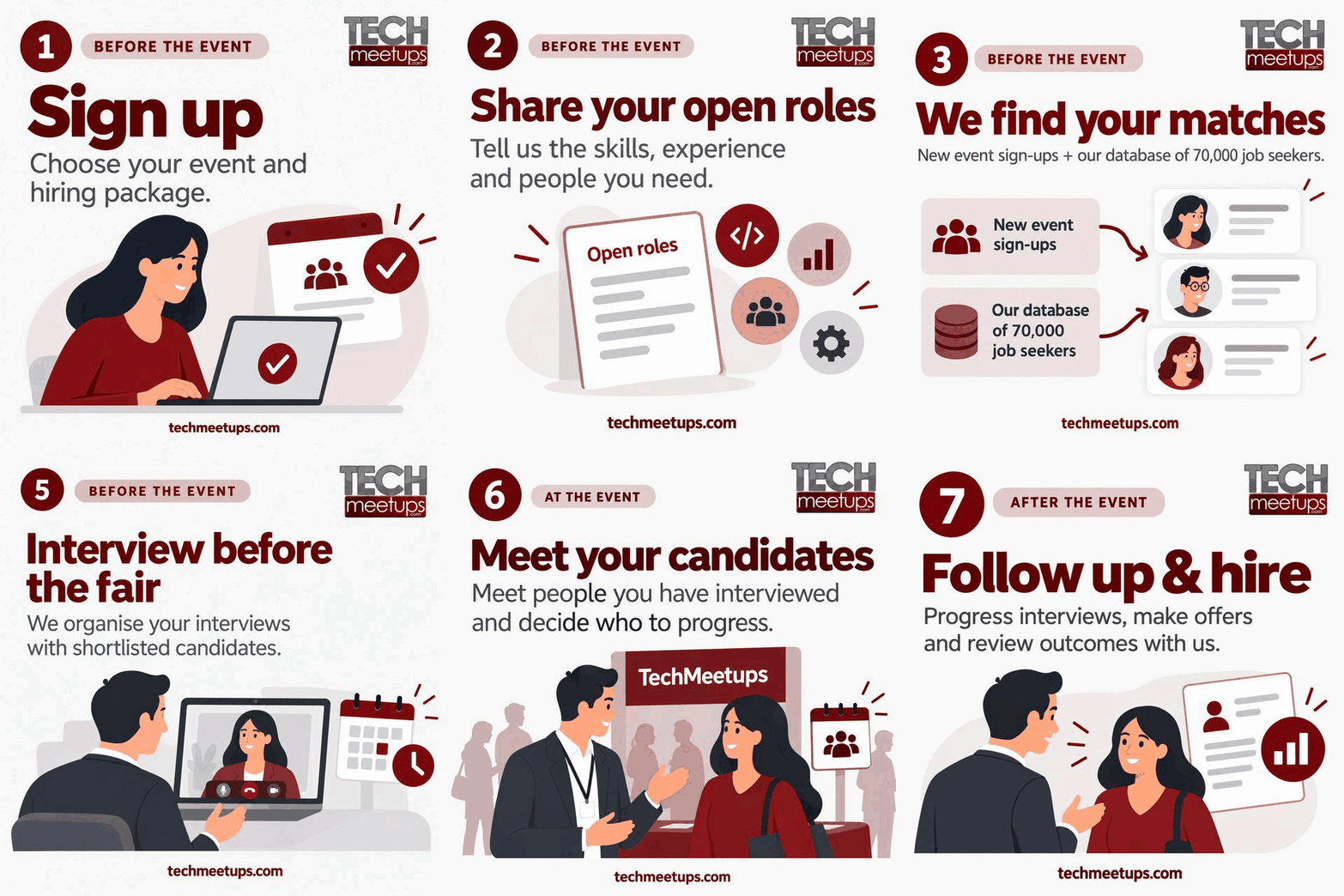
The surest way past any screening system is to meet the hiring team in person. At a job fair, your CV becomes the start of a conversation rather than a file in a queue.
Coming up in November is the Amsterdam Tech Job Fair on Thursday 12 November 2026, 18:00–21:00, an evening of one-to-one conversations between job seekers and hiring companies, with no presentations or speeches. Bring a CV that’s ready for both readers.
Order your CV Rewrite for €49, then get your ticket for the Amsterdam Tech Job Fair, 12 November.
See all upcoming TechMeetups job fairs, including Valencia on 6 May 2027.