
A year ago, most job seekers used AI to polish a sentence or two. Now AI agents can research a company, compare your CV with a job description, draft a tailored cover letter and set up a mock interview, all in a single session. That is a real advantage if you use it well. Used badly, it produces applications that look like everyone else’s and can quietly damage your credibility.
This guide covers where AI agents genuinely help in a tech job search, the pitfalls recruiters notice, and why the in-person side of hiring matters more than ever. If you’re job hunting this autumn, it’s also a good warm-up for the Barcelona Tech Job Fair on Wednesday 28 October.
You’re not the only one using AI
If you’re using AI to apply for jobs, you’re in good company. In a Gartner survey of 3,290 job candidates, 39% said they had used AI during the application process. The most common uses were generating text for a CV (54% of those users) and for a cover letter (50%).
Employers are using it too. In a separate Gartner survey, just over half of candidates (52%) believed AI was screening their application, yet only 26% trusted AI to evaluate them fairly. In other words, there’s a lot of AI on both sides of the table and not much trust in the middle. That’s exactly why the way you use these tools matters.

Where AI agents genuinely help
Think of an AI agent as a fast, tireless research assistant, not a ghostwriter. These are the jobs it does well:
- Company research. Ask an agent to summarise a company’s products, recent news, tech stack and hiring pages before you apply or walk up to their stand. Then check the key points yourself on the company’s own website.
- Matching your CV to a role. Paste in a job description and your CV and ask which requirements you already cover, which you can evidence better and which you genuinely lack. It’s a quick way to spot gaps before a recruiter does.
- Tailoring, not rewriting. Use AI to suggest which of your real achievements to move higher for a particular role, or to tighten a long bullet point. Keep the facts, numbers and voice your own.
- Interview practice. Ask an agent to play a hiring manager for a specific role and push you with follow-up questions. Practise answering out loud, then ask it which answers were vague.
- Language support. If you’re applying in Munich or Barcelona, AI can help you prepare a short introduction in German or Spanish.
The pitfalls recruiters notice
The risks are just as real as the benefits:
- Generic applications. If ten candidates ask the same tool to “write a cover letter for this job”, recruiters get ten letters that sound alike. Specific details from your own experience are what make you stand out, and AI can’t invent them for you.
- Made-up facts. AI tools can produce confident but wrong statements about a company, or embellish your experience. Anything you send is your responsibility, so check every claim, date and figure.
- Over-polished language. A CV full of buzzwords and identical sentence patterns can read as machine-written. Plain, concrete language about what you did and what changed as a result reads better to humans and machines alike.
- Privacy. Think before pasting personal data, references or a current employer’s confidential information into a public AI tool. Remove anything you wouldn’t want stored.
- Crossing the line in assessments. Using AI to prepare is fine; using it to answer live tests or interviews for you is not. Employers are increasingly alert to this. Gartner found that 6% of candidates admitted to interview fraud, and it predicts that by 2028 one in four candidate profiles worldwide will be fake. Getting caught can end an application instantly.
How Europe regulates AI in hiring
In Europe, AI used in hiring is taken seriously by regulators. Under the EU AI Act, systems used to filter job applications and evaluate candidates are classed as high-risk, which means stricter obligations for the organisations that build and use them. For candidates, the practical lesson is simple: it’s reasonable to ask an employer how applications are screened and whether a person reviews them. Many employers will be glad you asked.

Why face-to-face matters more now
When written applications start to look alike, a real conversation becomes the best way to show who you are. Gartner’s research points the same way: 62% of candidates said they were more likely to apply if an organisation required in-person interviews.
That’s the thinking behind our job fairs. There are no presentations or speeches, just direct conversations between job seekers and hiring companies. In a few minutes you can explain your projects and ask about the team, with no algorithm in between.

A simple AI routine for fair season
Here’s a practical routine for the week before a job fair:
- Shortlist employers. Check the event page and use an agent to summarise each company you want to meet. Verify the details yourself.
- Run a gap check. Compare your CV with two or three relevant job descriptions and note what you need to evidence better.
- Fix your CV properly. Make sure your CV is clean, specific and easy to scan, by both software and people. If you’d like expert help, our Professional CV Rewrite, Redesign & Proofreading service (€49) gives you an ATS-friendly CV, LinkedIn profile text and banner, and a targeted cover letter once your target role is known.
- Rehearse your introduction. Use an agent to role-play a recruiter, then practise your 30-second pitch out loud until it sounds natural.
- Follow up personally. After the fair, send a short message within 48 hours that mentions something specific from your conversation. Write that one yourself.
Meet employers in Barcelona
The Barcelona Tech Job Fair 2026 takes place on Wednesday 28 October 2026, 18:00–21:00, at Hotel Ilunion Barcelona (Carrer de Ramon Turró, 196-198).
Munich update: the Munich Tech Job Fair moves to Thursday 22 April 2027, 18:00–21:00, at meetinn Neuaubing. Existing tickets remain valid.
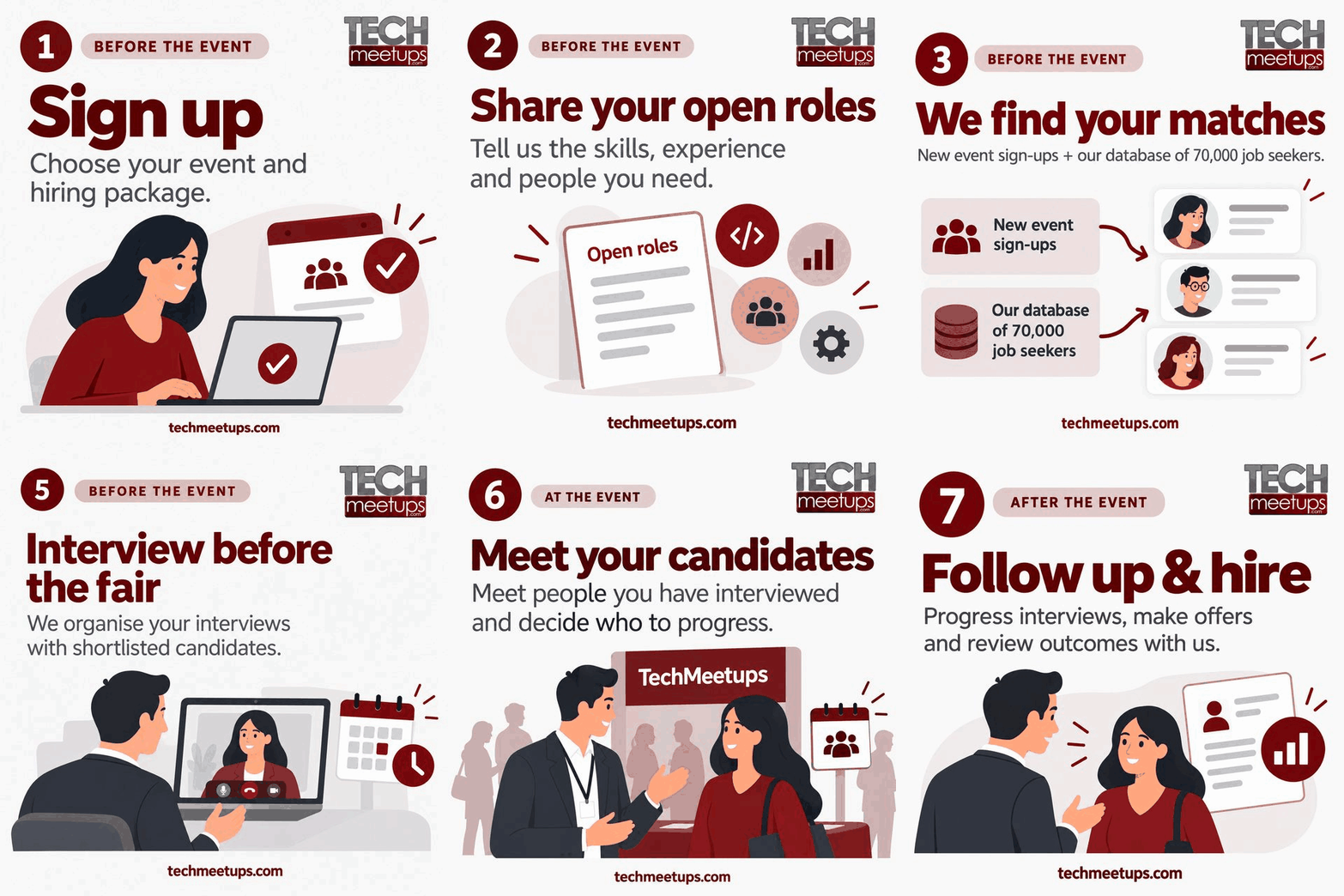
Employers: exhibitor and hiring packages are available on the event page, so you can meet candidates in person and see their skills beyond the CV.
Use AI to prepare, then show up as yourself
AI agents can make your job search faster and better organised, but they can’t build relationships for you. Use them for research, practice and admin, keep every application honest and specific, and save your best effort for the conversations that lead to offers.
Get your ticket for the Barcelona Tech Job Fair, 28 October, and make sure your CV is ready with our CV Rewrite service.
See all upcoming TechMeetups job fairs, including Amsterdam and Valencia in November.